
Vietnam Personal Income Tax for Foreigners 2026: Rates, Filing & Tips
22 Apr, 2026
Vietnam Personal Income Tax — Tax Residency Rules for Foreigners
Your PIT liability in Vietnam depends entirely on whether you are classified as a tax resident or non-resident. The threshold is 183 days in a calendar year — or 12 consecutive months from the date of first arrival. If you meet either condition, you are a tax resident for that period and taxed on your worldwide income at progressive rates. If you fall below 183 days, you are a non-resident and taxed at a flat 20% on Vietnam-sourced income only.
Most long-term expats renting in HCMC — whether in Thao Dien, An Phu or Binh Thanh — will qualify as tax residents. This is worth confirming early in the tax year, not at filing time. Residency status determines not just your rate but your eligible deductions, so getting this wrong has downstream consequences. If you're new to HCMC and still searching for long-term accommodation, browse apartments for rent in District 2 — establishing a fixed registered address is also relevant for tax documentation purposes.
Vietnam PIT Rates for Foreign Tax Residents in 2026
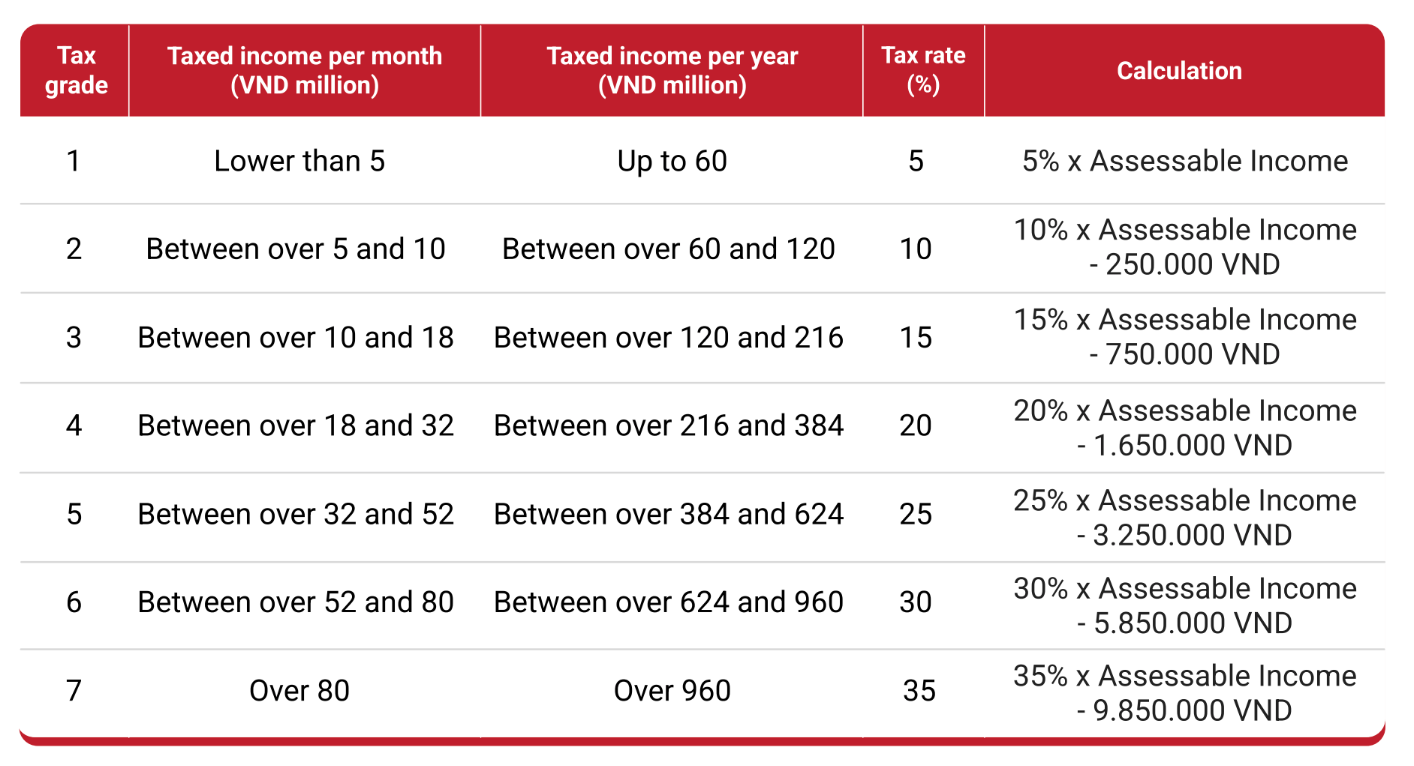
Tax residents are subject to a progressive PIT schedule on employment income:
| Monthly Taxable Income (VND) | Rate |
|---|---|
| Up to 5,000,000 | 5% |
| 5,000,001 – 10,000,000 | 10% |
| 10,000,001 – 18,000,000 | 15% |
| 18,000,001 – 32,000,000 | 20% |
| 32,000,001 – 52,000,000 | 25% |
| 52,000,001 – 80,000,000 | 30% |
| Over 80,000,000 | 35% |
The top rate of 35% applies to monthly taxable income exceeding approximately $3,200 USD — a threshold many senior expat professionals exceed. Personal deductions reduce your taxable base: the personal deduction is 11,000,000 VND/month for the taxpayer, plus 4,400,000 VND/month per qualifying dependent. Mandatory social insurance contributions (if applicable) are also deductible.
Non-residents pay a flat 20% on all Vietnam-sourced income with no deductions available — a significant difference if you are close to the 183-day threshold.
Vietnam PIT Deductions & Double Taxation Treaties for Expats in HCMC
Beyond the personal and dependent deductions, tax residents can claim deductions for compulsory insurance contributions paid in Vietnam. Voluntary pension fund contributions are also deductible up to VND 1,000,000/month.
Vietnam has signed Double Taxation Agreements (DTAs) with over 80 countries, including the UK, USA, Australia, France, Germany, Japan, South Korea, and Singapore. If your home country has a DTA with Vietnam, you may be able to offset Vietnamese PIT against your home country tax liability — preventing double taxation on the same income. The mechanics vary by treaty and personal situation, so professional tax advice is strongly recommended if your employment income spans multiple jurisdictions.
One practical point: many expats in HCMC have their PIT withheld and filed by their employer. If you're employed by a Vietnamese entity or a foreign company with a registered presence here, your employer typically handles monthly PIT withholding and annual finalisation on your behalf. Self-employed expats or those on independent contracts must register and file independently.
Vietnam PIT Filing Process — Deadlines & Practical Tips for Expats
Annual tax finalisation deadline: 31 March of the following year for individuals filing independently. Employers handle monthly withholding on your behalf if you're on a local payroll.
Key steps for independent filers:
- Register for a Personal Tax Code (MST) at the local tax department if you haven't already
- File annual PIT finalisation via the General Department of Taxation's online portal (thuedientu.gdt.gov.vn)
- Gather all income documentation: employment contracts, payslips, offshore income records if applicable
- Submit a dependent registration if claiming deductions for children or dependents
Practical tips: Keep records of all income sources — including rental income from overseas properties if you are a tax resident. Currency conversion for tax purposes uses the official exchange rate published by the State Bank of Vietnam. And if you're on a package that includes rent allowances or housing benefits, these are generally taxable as employment income in Vietnam.
Settling your tax situation and getting your address registered are two of the most important admin tasks when moving to HCMC. If you're still finding your long-term home, explore serviced apartments in District 1 or apartments in Thao Dien — a stable registered address makes the rest of the paperwork considerably easier.
Ready to find your home in Ho Chi Minh City?
📞 Call / WhatsApp / Zalo: +84 909 457 542 📧 Email: info@vnrenthome.com 🌐 Browse listings: vnrenthome.com
We respond within a few hours — often faster.
Related Articles You May Find Useful
Explore more guides to help you make the most of expat life in Ho Chi Minh City:
- HCMC Rental Market Update Q1 2026 — Current rental prices across all major expat districts.
- HCMC Rental Market Update Q2 2026 — Latest price trends and Metro Line 1 impact.
- Luxury Villa Market in Thao Dien 2026 — Prices, supply and what expat families choose.
- New Apartment Projects in HCMC 2026 — Major developments reshaping the expat rental market.
- Serviced Apartment vs Condominium in HCMC 2026 — A practical comparison to help choose the right rental type.
- Villa Rental Price Guide Saigon 2026 — Complete villa rental prices across all HCMC districts.
- Expat Salary Guide Ho Chi Minh City 2026 — Budget your housing based on typical expat packages.
